
If you run a SaaS company (or any business that depends on cloud apps to operate), your “IT” isn’t just a few laptops and a Wi‑Fi router anymore.
It’s access control, uptime, vendor sprawl, security policies that people actually follow and it’s backup and recovery that works when you’re tired and stressed.
For many growing teams, choosing the right IT Service Provider South FL is the difference between “we can ship” and “we’re stuck troubleshooting.”
And in South Florida—where a lot of businesses are growing fast, hiring remote talent, and juggling Microsoft 365, cloud infrastructure, and compliance expectations—the difference between a vendor that responds and a provider that prevents becomes painfully obvious.
This guide is written for saas-space.com readers who want a practical, no‑fluff way to evaluate an IT partner. We’ll unpack what top South Florida MSPs tend to offer, where they differentiate, and how to choose a provider that protects your business while helping your team move faster.
Why “IT Service Provider” Means Something Different in 2026
Ten years ago, many “IT companies” were mostly break/fix: something breaks, you call, they show up. The modern version is a managed service provider (MSP)—a team that proactively monitors, patches, secures, and supports your environment for a predictable monthly fee.
For SaaS‑forward businesses, that shift matters because your biggest risks aren’t just hardware failure. They’re:
- A compromised Microsoft 365 account that spreads phishing internally
- A laptop lost in transit with no disk encryption
- Shadow IT tools connected to Google Drive or M365 without visibility
- A ransomware incident that turns into a multi‑day shutdown
- A “simple” onboarding process that takes 3 days and kills momentum
In other words: you don’t need “someone who can fix computers.” You need a provider who can run IT like an operating system for your business—and that’s exactly what you should expect from an IT Service Provider South FL worth partnering with.
What the Best IT Service Provider South FL Typically Offer
When you look at top‑ranking IT providers and MSPs across South Florida, their service menus often overlap. The real difference is how they deliver, what they prioritize, and how mature their processes are.
At a minimum, any IT Service Provider South FL you shortlist should be able to explain these clearly—what’s included, how it’s delivered, and how success is measured.
Managed IT Service Provider South FL That Are Actually Proactive
A true managed IT plan usually includes:
- Device and server monitoring (alerts before users feel issues)
- Patch management (OS + third‑party apps)
- Help desk support (remote‑first, fast response, clean ticketing)
- Network management (Wi‑Fi, firewall, switches, ISP coordination)
- Vendor management (you shouldn’t be calling five different companies)
If the provider’s plan sounds like “unlimited support” but doesn’t clearly define monitoring, patching, and standards, it’s often reactive support wearing a managed‑services costume.
What to ask:
- What’s your patching cadence?
- What do you standardize (firewalls, endpoint security, backups)?
- Do you do quarterly reviews or just close tickets?
Cybersecurity as a Built‑In Layer, Not an Upsell for IT Service Provider South FL
Security can’t be “optional” anymore. South Florida providers increasingly position cybersecurity as a core differentiator, commonly bundling:
- Endpoint protection (modern EDR‑style tools, not just basic AV)
- Email security and phishing defense
- MFA enforcement and conditional access
- Security awareness training (short, ongoing, not a once‑a‑year checkbox)
- Dark web monitoring and credential alerts
- Policy baselines (admin rights, encryption, device control)
A good MSP makes secure behavior the default. A mediocre MSP sells you tools and hopes your team uses them.
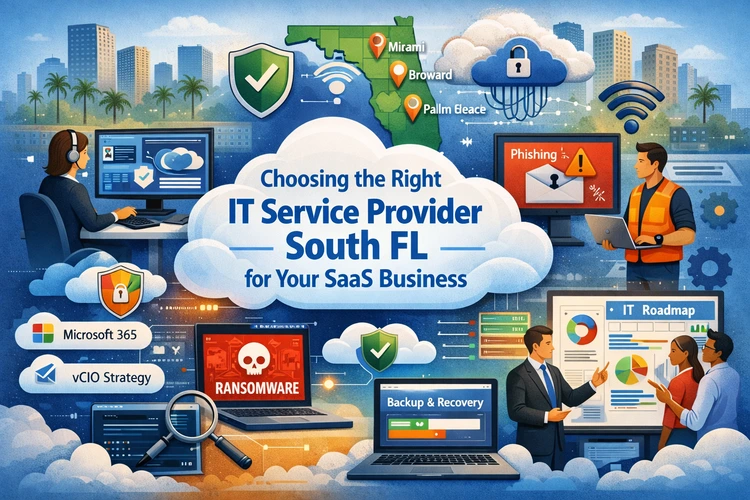
Microsoft 365 Optimization (Because Most “M365 Users” Aren’t Using It Well)
If your organization is on Microsoft 365, your IT provider should know how to:
- Secure sign‑ins with Conditional Access
- Standardize SharePoint/OneDrive permissions
- Support Teams calling/meetings and collaboration workflows
- Implement mobile device management (MDM) so lost phones don’t become incidents
- Create onboarding/offboarding flows that don’t rely on tribal knowledge
This is where SaaS companies win big: productivity and security improve together when M365 is configured properly.
Understanding the difference between basic antivirus and true defense against Security Protecting data from advanced cyber threats can help you ask smarter questions when evaluating MSP security capabilities.
Business Continuity That Goes Beyond “We Have Backups”
Backups are only valuable if you can restore quickly and confidently.
A more mature provider talks about:
- Image‑based backups (systems, not just files)
- Backup verification and restore testing
- Clear recovery time objectives (RTO) and recovery point objectives (RPO)
- Ransomware‑resilient storage and secure replication
What to ask:
- How often are backups tested?
- What’s the typical restore time for a workstation vs. a server?
- Can you demonstrate a restore process?
vCIO Strategy (So You Don’t Drift Into Tool Chaos)
The best IT providers don’t just solve today’s tickets. They help you plan:
- 12–36 month IT roadmaps
- Budget forecasting
- Compliance planning
- Vendor consolidation (the hidden source of IT cost creep)
- Risk assessments and prioritized remediation
For SaaS companies, this often becomes the difference between “We’re constantly switching tools” and “We operate with a deliberate tech stack.”
The Real Differentiators That Separate a Great MSP From a Pretty Website
Most providers can list similar services. What you’re really choosing is an operating model.
Clear, Flat‑Rate Pricing That Matches the Support Promise
Many MSPs advertise flat‑rate IT. That can be great—if it truly covers what you need.
Look for transparency on:
- What’s included vs. “project work”
- Whether onsite support costs extra
- Whether security tools are bundled or line‑item add‑ons
- How onboarding is priced (and how long it takes)
A good rule: if pricing is “flat,” but every meaningful improvement becomes a separate proposal, you’re not buying managed services—you’re buying a subscription to ticketing.
Documented Standards (Because Consistency Is a Security Feature)
Ask whether they have standards for:
- Firewalls
- Endpoint security
- Device setup and encryption
- Admin rights
- Backups
- M365 configuration
If the answer is vague, you’re likely dealing with a provider where outcomes depend on who answers the ticket.
Speed and Discipline in IT Service Provider South FL
Many providers advertise fast response times. That’s helpful, but speed without discipline creates chaos: quick fixes, recurring issues, and inconsistent configurations.
The best IT partners are fast and systematic:
- Root cause analysis for recurring issues
- Preventive maintenance
- Quarterly reviews that drive measurable improvements
- Consistent onboarding/offboarding workflows
A Practical Scorecard for Hiring an IT Service Provider South FL
Use it when comparing any IT Service Provider South FL—whether you’re based in Miami, split between multiple offices, or running a remote-first team.
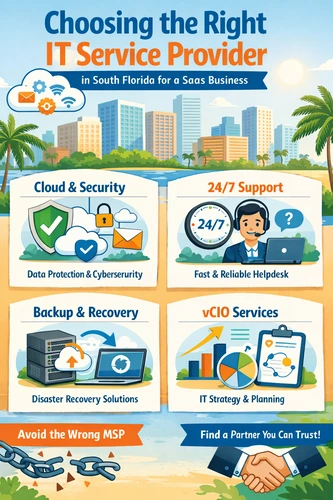
Operational Fit in IT Service Provider South FL
- Do they support your business hours and time zone needs?
- Is their help desk 24/7, or “after‑hours emergency only”?
- Do they have coverage for onsite needs in Miami/Broward/Palm Beach?
Security Fit in IT Service Provider South FL
- Do they enforce MFA everywhere by default?
- Do they manage endpoint protection and email security?
- Do they provide training and phishing simulations?
- Can they show a security baseline checklist?
SaaS and Cloud Fit in IT Service Provider South FL
- Can they support Microsoft 365 end‑to‑end (security + productivity)?
- Are they competent with cloud environments and identity management?
- Can they integrate systems so onboarding is fast and standardized?
Business Fit in IT Service Provider South FL
- Do they offer vCIO guidance and roadmap planning?
- Do they help you control costs and reduce tool sprawl?
- Can they align IT decisions with growth goals (hiring, expansion, compliance)?
Proof and Process
- Can they walk you through onboarding step‑by‑step?
- Do they document environments and share the documentation?
- Do they provide reports that matter (not just “tickets closed”)?
What “South Florida” Adds to the Buying Decision
Local intent matters for this keyword for a reason—people don’t just want “IT help,” they want an IT Service Provider South FL that can show up when it counts and still deliver modern, cloud-first support the rest of the time. Even SaaS‑heavy businesses still need occasional onsite support—especially during:
- Office moves
- Network upgrades
- New site buildouts
- Hardware rollouts
- Incident response when remote work isn’t enough
South Florida also has a lot of businesses that sit in regulated or semi‑regulated spaces (finance, healthcare‑adjacent, professional services). Even if you’re not formally required to be compliant, your customers increasingly expect you to behave like you are.
That’s why the best providers in this region tend to emphasize:
- Structured security programs
- Backup and continuity planning
- Consistent monitoring and maintenance
- Executive‑level IT planning
The “Right IT Service Provider South FL Provider” Should Make Your Business Feel Lighter
Here’s a simple litmus test that rarely fails:
A good IT partner reduces cognitive load.
Your team should stop thinking about:
- “Who has access to what?”
- “Are we backed up?”
- “Is this laptop secure?”
- “What happens if someone gets phished?”
- “Why does onboarding take forever?”
Instead, IT becomes a quiet advantage—like great accounting or a clean billing system. You only notice it when it’s done badly.
Final Thoughts: Don’t Buy IT Support. Buy a System.
The best MSP relationships don’t feel like vendor relationships. They feel like an extension of your operations team.
If you’re a SaaS‑led business in South Florida, your IT provider should help you:
- Scale onboarding and access cleanly
- Reduce incidents through proactive maintenance
- Strengthen security without slowing teams down
- Build continuity so one bad day doesn’t become a business crisis
- Make smarter tech decisions with a roadmap (not reactive purchases)
In a market where many providers sound the same, the winner is the one who can prove they run a repeatable system—one that keeps your people productive, your data protected, and your growth unhindered.
If you’d like, share the industry (SaaS, agency, healthcare, finance, etc.), headcount, and whether you’re Microsoft 365 or Google Workspace—and I’ll tailor a short “MSP requirements doc” you can send to providers so they bid apples‑to‑apples (and you avoid the classic gotchas).
About the Author
Vince Louie Daniot is a seasoned SEO strategist and tech copywriter focused on SaaS, IT services, and digital transformation. With 10+ years of experience in long-form content strategy, he helps brands turn complex topics—like cybersecurity, managed IT, and cloud operations—into clear, engaging articles that perform on Google. His work is built around search intent, trust signals, and readability that keeps people scrolling.

- 10 Best Survey Plugins in WordPress - April 2, 2026
- 5 Best LMS Plugins in WordPress - March 26, 2026
- 6 Best Poll Plugins in WordPress - March 23, 2026

