As artificial intelligence becomes part of everyday work, small businesses are discovering how “agentic” AI can unlock scale without adding headcount.
Agentic workflow tools today combine automation and intelligence, giving teams digital agents that handle routine tasks, learn from data, and work across business systems.
Whether you’re automating sales follow-ups, content creation, or customer support, these platforms make AI accessible to smaller teams ready to grow efficiently.
What Is Agentic AI?
Agentic AI refers to systems that can take initiative within defined boundaries, planning, reasoning, and acting on their own rather than waiting for a single instruction.
In workflow automation, this means tools can now interpret context, retrieve information, and dynamically adjust tasks.
For example, an agentic system might not only post an update when inventory runs low but also analyze sales trends, draft supplier emails, and automatically schedule restocks.
For small businesses, agentic AI removes repetitive busywork and introduces scalable decision-making once reserved for enterprise-level systems.
How We Selected the Top Agentic AI Tools on the List
To find the most relevant tools for small and mid-sized businesses, we evaluated platforms based on:
- Accessibility: No-code or low-code options usable by non-technical teams.
- Agentic Capabilities: Ability to plan, reason, or adapt beyond static rules.
- Scalability and Affordability: Transparent pricing and small-team suitability.
- Integrations and Ecosystem Support: Connections to popular SaaS products.
Security and Governance: Compliance and data protection for growing firms.
The 8 Best Agentic Workflow Platforms for Small Businesses in 2026
We narrowed this guide down to eight tools that balance true agentic capabilities with real-world usability and pricing for smaller teams.
1. Make
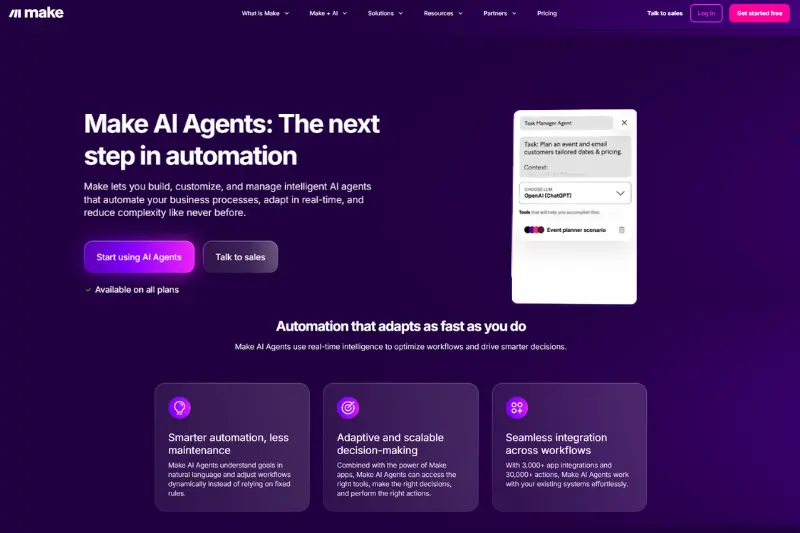
What It Is: Make is a visual-first automation and AI workflow platform that allows teams to design, test, and scale processes across departments without coding. Its visual, drag-and-drop interface turns logic into an interactive diagram, showing how data moves between tools and where AI agents step in. Originally built for creative and operations teams, Make now supports everything from marketing sequences to enterprise-grade agentic automation.
By combining drag-and-drop usability with advanced features such as HTTP requests and data transformation, it bridges the gap between no-code simplicity and technical flexibility. This dual nature makes it one of the most accessible yet powerful automation environments available to small businesses.
Who It’s For: Ideal for teams that want power without coding. Even less-technical teams can design everything from simple automations to enterprise-grade AI systems.
Key Features: Make offers a fully visual Scenario Builder with unlimited branching, conditional logic, and parallel processing. Users can deploy Make AI Agents that reason over data, execute actions, and adapt in real time.
Make Grid provides a top-down view of every automation and AI agent across the organization, improving observability and governance and helping users to scale at speed. Advanced modules support array handling, JSON parsing, file manipulation, and real-time webhooks, while 3,000 + native integrations connect to major SaaS tools.
Pricing & Plans: Free tier available; paid plans start around 9 USD per month for 10,000 credits (annual billing).
Pros: Visual interface clarifies complex logic · Extensive integration library · Cost-efficient per operation · AI Agents extend capability beyond rules · Visual orchestration layer for improved control · Enterprise compliance options (SOC 2, SSO). Cons: Usage-based billing can spike with heavy polling · Some niche apps still require HTTP modules.
2. Lindy AI
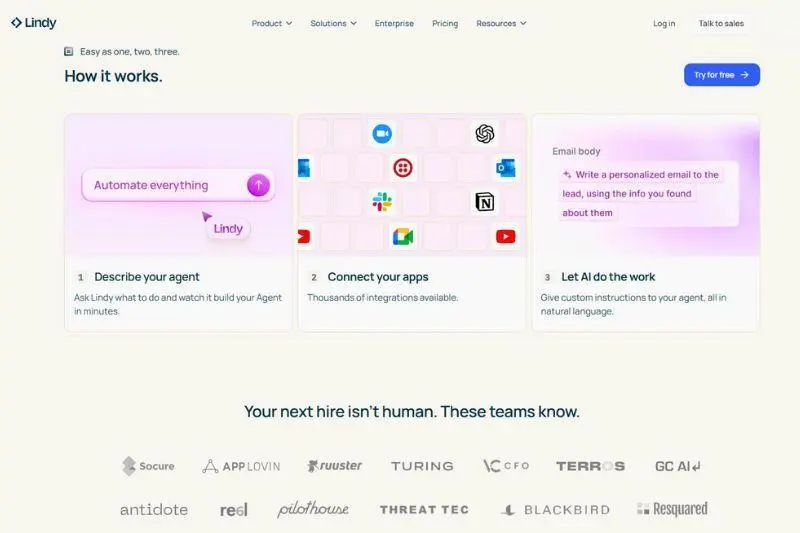
What It Is: Lindy AI is a no-code platform for creating digital coworkers that assist with administrative and operational tasks through natural-language instructions. Each “Lindy” functions as a customizable agent able to read context, execute tasks, and report results. Founded with the goal of democratizing digital assistance, Lindy brings conversational AI to everyday business operations.
It allows small organizations to create purpose-built agents that handle scheduling, inbox management, lead follow-ups, or research tasks that would normally demand human attention. The system learns from context and can reference prior conversations to refine its responses.
Who It’s For: Perfect for small business owners, sales reps, and founders who need lightweight, personalized AI support without a technical setup.
Key Features: Lindy AI provides a dialogue-driven interface for task creation, memory for storing instructions, and secure data connections to email, calendars, and CRMs. Its Knowledge Upload feature lets users train agents with internal documents, ensuring personalized, brand-specific output. Integration with messaging apps and APIs allows Lindy agents to collaborate across platforms while maintaining a consistent tone and accuracy.
Pricing & Plans: Free trial available; paid plans start from ≈ 20 USD per month.
Pros: Intuitive conversational design · Fast setup for everyday tasks · Personalized memory for context retention · Affordable for individuals · Expanding third-party integrations
Cons: Limited complex workflow logic · Fewer enterprise connectors · Dependent on natural-language accuracy · Still maturing analytics and reporting features.
3. Relevance AI
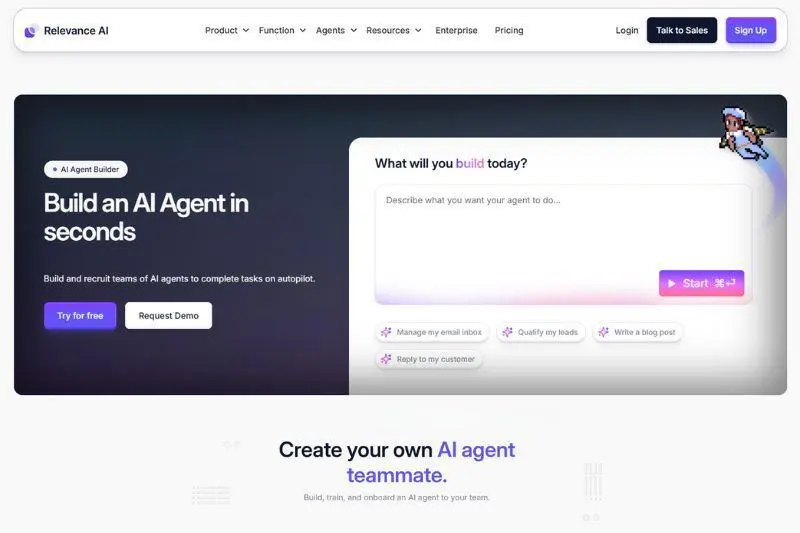
What It Is: Relevance AI provides a workspace for building AI agents that analyze information, reason over context, and automate decisions. Its foundation lies in vector search and retrieval-augmented generation (RAG), enabling agents to interpret and act on large collections of unstructured data such as documents or customer feedback.
For small businesses, it functions as a self-service platform for creating internal research assistants or data analysts that combine natural-language understanding with workflow triggers.
Who It’s For: Ideal for data-driven small businesses that rely on research, content, or insights from large document sets.
Key Features: Relevance AI’s dashboard supports agent creation through drag-and-drop logic and natural-language instructions. Built-in embeddings, similarity search, and analytics dashboards enable document clustering, question-answering, and automated report generation. It connects with productivity suites and databases to fetch and enrich results dynamically.
Pricing & Plans: Free trial available; team plans start ≈ 25 USD per user per month.
Pros: Strong RAG capabilities · Excellent data-analysis automation · Supports multi-agent collaboration · Clean, modern UI · Transparent pricing.
Cons: Requires curated data sources · Limited marketing or CRM automation · Advanced setup may need technical input · Smaller integration list than larger iPaaS tools.
4. Haptik Interakt
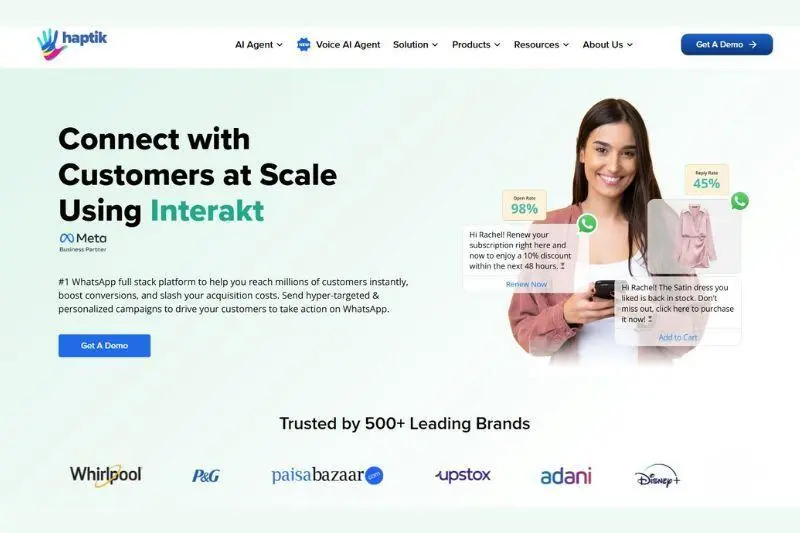
What It Is: Haptik’s Interakt platform brings conversational agentic AI to small businesses through automated customer-engagement workflows. Originally developed for WhatsApp commerce, it now spans messaging, CRM, and support automation for SMBs worldwide.
By combining chatbots, notifications, and lead-management functions, it acts as both a sales assistant and a customer-service layer that reduces manual outreach.
Who It’s For: Small businesses needing AI-powered customer support, lead generation, and WhatsApp commerce.
Key Features: Interakt offers prebuilt conversational templates, drag-and-drop flow design, and built-in CRM contact management. Agents handle FAQs, order tracking, payments, and feedback collection in real time. Integration with Shopify, Razorpay, and Meta tools simplifies omnichannel operations. Analytics dashboards measure engagement and conversion metrics.
Pricing & Plans: Free trial available; business plans from ≈ 15 USD per month based on usage.
Pros: Quick to deploy · Affordable for SMBs · Optimized for WhatsApp · Native e-commerce and payment links · Real-time customer analytics.Cons: Messaging-centric · Limited internal workflow automation · Customization bound by WhatsApp API · Fewer integrations outside retail and support.
5. Sweep
What It Is: Sweep AI applies agentic automation to go-to-market operations, using AI agents to manage data hygiene, sales forecasting, and marketing execution. Designed for revenue teams, it automates routine CRM upkeep and performance tracking.
Its goal is to minimize the manual administrative load in sales operations by having agents proactively identify issues, update records, and suggest next best actions.
Who It’s For: Go-to-market teams in small businesses wanting smarter sales and CRM workflows.
Key Features: Sweep connects with leading CRMs and marketing tools, applying AI reasoning to analyze pipeline trends and lead behavior. Agents can autonomously adjust campaign parameters or notify managers when thresholds are breached. Built-in dashboards provide transparency on performance metrics.
Pricing & Plans: Pricing upon request after demo.
Pros: Purpose-built for sales efficiency · Improves CRM accuracy · Predictive analytics support · Reduces manual data entry · Integrates well with HubSpot and Salesforce.
Cons: Enterprise-leaning onboarding · Limited outside GTM use cases · Pricing not fully public · Requires solid CRM infrastructure.
6. Beam
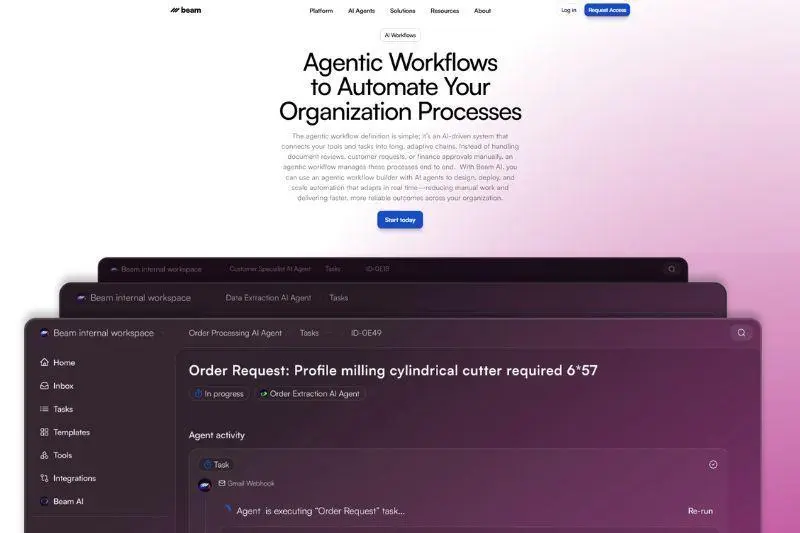
What It Is: Beam AI delivers agentic process automation for operations, finance, and knowledge workflows. It allows businesses to design AI agents that interpret inputs, decide optimal next steps, and execute actions across systems.
By combining rule-based logic with reasoning models, Beam turns repetitive decision chains into autonomous routines that scale efficiently.
Who It’s For: SMBs needing AI decision-making within existing workflows such as finance, logistics, or HR.
Key Features: The platform features a graphical agent designer, prebuilt logic blocks, and connectors to popular business databases and APIs. Its AI reasoning engine evaluates variables such as cost, time, and performance, then recommends or implements actions automatically. Detailed audit logs support governance and explainability.
Pricing & Plans: Free trial available; pricing starts ≈ 40 USD per user per month.
Pros: Strong decision-automation logic · Versatile integrations · Transparent governance controls · Scalable across departments · Good documentation.
Cons: Less focus on marketing tasks · Requires process mapping expertise · Interface is more technical than visual · Limited brand recognition.
7. N8n

What It Is: n8n is an open-source automation and agentic workflow builder that gives businesses ownership of data while enabling powerful multi-step automations. Heavily favored by developers, it’s also been adopted by startups and data teams with strong tech knowledge.
n8n can run on local servers or private clouds, allowing companies to comply with strict data-residency requirements.
Who It’s For: Small tech-savvy teams or startups that want control over infrastructure, data, and custom agent behavior.
Key Features: Its node-based editor supports complex branches, triggers, and API calls. Users can embed custom JavaScript or Python to extend behavior beyond visual blocks. Recent releases include native AI connectors for OpenAI, Anthropic, and custom LLM endpoints, enabling reasoning and autonomous task execution. Pricing & Plans: Free for self-hosting; cloud plan starts ≈ 20 EUR per month.
Pros: Fully open-source · Highly customizable · Robust community plugins · Supports on-prem or cloud · Strong security control.
Cons: Requires deep technical expertise · UI less refined than SaaS rivals · Limited official support on free tier · Initial setup time higher for beginners · Costs can quickly become exorbitant.
8. Tray.ai
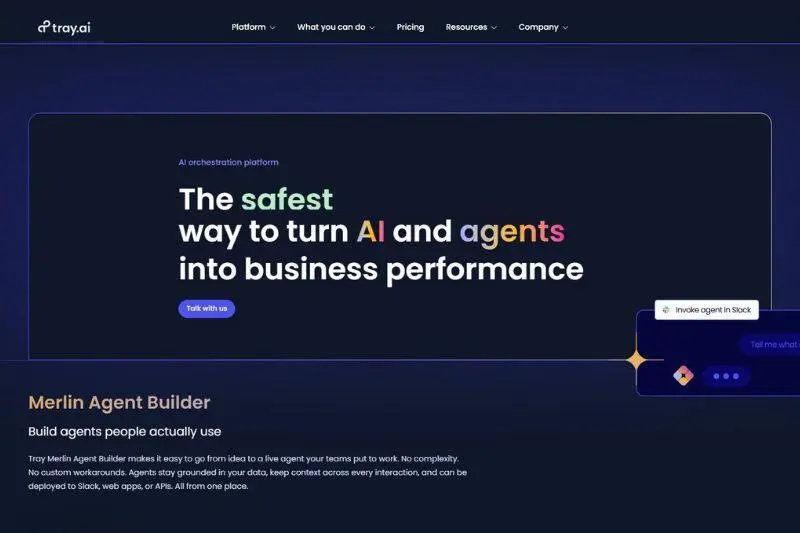
What It Is: Tray.ai is a low-code automation and AI orchestration platform built to connect systems and coordinate processes across applications. Its architecture combines traditional integration capabilities with AI agents that manage data flow and trigger logic dynamically.
The platform serves as an integration backbone for fast-growing SMBs seeking enterprise reliability without extensive coding.
Who It’s For: Rapidly scaling SMBs and mid-market firms that need flexibility and enterprise-ready integration in one solution.
Key Features: Tray’s Merlin AI Agent Builder enables the creation of autonomous agents that invoke workflows, monitor conditions, and act across connected systems. The Universal Automation Cloud centralizes governance, error handling, and versioning. Native connectors cover thousands of business applications, while REST API support extends reach to custom systems.
Pricing & Plans: Free trial available; paid plans start around $695 per month for standard tiers.
Pros: Powerful orchestration engine · Robust security and compliance · Reusable workflow components · Supports hybrid AI + human processes · Highly scalable.
Cons: High entry price for small firms · Setup can be complex · Requires training for advanced logic · Less cost-efficient for light usage.
Agentic AI Categories
Automation Agents: Tools like Make and Tray specialize in end-to-end process automation, connecting apps and systems so tasks happen autonomously based on business rules and AI logic.
Conversational Agents: Haptik Interakt and Lindy AI help SMBs engage customers or employees through natural dialogue, handling sales and support tasks hands-free.
Analytical and Decision Agents: Relevance AI and Beam AI enable data-driven decision support, analyzing documents, metrics, and insights to recommend or execute next steps.
How to Choose the Right Agentic AI Workflow Platform
| Platform | Best For | Key Strength | Starting Price |
| Make.com | Visual automation platform for all teams | No-code AI agents + flexible canvas | From $9 / month |
| Lindy AI | Personal assistant automation | Conversational task delegation | From $20 / month |
| n8n | Technical users needing control | Open-source custom agent hosting | From €20 / month (cloud) |
| Relevance AI | Data-heavy teams | RAG and reasoning agents | From $25 / user/month |
| Haptik Interakt | Customer support + sales | Conversational commerce automation | From $15 / month |
| Sweep AI | Sales and marketing teams | Agentic GTM automation | Quote based |
| Beam AI | Operations + decision automation | AI logic engine for processes | From $40 / user / month |
| Tray.ai | Growing SMBs + enterprise connectivity | Low-code agent orchestration | From $695 / month |
When choosing, consider three key factors:
- Technical skill level: Non-technical teams may prefer Make or Lindy; technical teams may prefer n8n or Beam.
- Workflow scope: Decide whether you need customer-facing agents (Haptik) or internal process automation (Tray, Make).
Budget and scale: Start with freemium or affordable plans and expand as usage grows.
Conclusion
Agentic AI is becoming one of the most practical ways for small businesses to scale without increasing headcount. From automating routine workflows to supporting decision-making and customer engagement, these tools give smaller teams the kind of leverage that used to require full operations or support departments.
What matters most isn’t choosing the “flashiest” tool, but selecting the right match for your team’s skills, systems, and growth stage. Some platforms shine in automation, others in conversation or analytics, and each one on this list brings a different strength to the table.
The next step is simple: pick one tool that aligns with your immediate bottleneck—workflow automation, customer support, research, sales, or data—and start experimenting. Even a single agentic workflow can create momentum, free up meaningful time, and open the door to more scalable, AI-powered operations.
Read and learn about more useful digital tools on SaaS Space Blog.
Frequently asked questions
What is the main benefit of agentic AI for small businesses?
The biggest benefit is that agentic AI automates tasks that normally require human judgment, such as prioritizing tasks, responding to context, or making simple decisions. This reduces manual work, speeds up operations, and helps small teams work at a level that used to require more staff.
Can I use agentic AI without technical skills?
Yes. Many platforms offer no-code or conversational builders so non-technical users can create and manage AI agents. Tools like Make or Lindy AI let you set up workflows, automations, or assistants through visual editors or natural-language instructions.
Are agentic AI tools secure for handling customer data?
Most leading platforms provide strong security features including encryption, GDPR compliance, and SOC 2 certification. Still, every business should review a tool’s data-handling policies, hosting options, and permissions to ensure it meets their internal standards.
What’s the difference between agentic AI and regular automation?
Agentic AI can interpret context, reason about next steps, and adjust its actions dynamically. Traditional automation follows predefined rules and stops when something unexpected happens. Agentic tools are more adaptable, making them ideal for small businesses with changing workflows.

- Choosing the Right IT Service Provider South FL for a SaaS-Driven Business (Without Getting Locked Into the Wrong MSP) - January 30, 2026
- Best AI-Powered Domain Name Generators for Startups (2026) - January 29, 2026
- 8 Best Agentic Workflow Tools for Small Businesses Ready to Scale with AI - December 9, 2025