
There is a particular kind of evolution that happens in mature software categories when new technology arrives. It is gradual at first, mostly invisible outside of engineering teams. Then, at some point, a major player makes a public move that signals the shift is real and the broader industry has to take it seriously. LambdaTest is now TestMu AI, which is exactly that kind of signal. The transformation took years of product investment and reflects genuine changes in what AI can realistically do for software quality assurance. Understanding why it matters requires tracing the arc from where testing was to where it stands now.
Testing Before AI: Powerful but Limited
Automated testing in its classical form is built on a clear logic: define expected behavior, execute the application, compare actual output against expectation, and report pass or fail. This model has served the discipline for decades and remains the foundation of most test automation today.
The limitation is not in the model itself but in what it cannot do on its own. Classical test automation has no concept of novelty or pattern. It cannot notice that a test it has run a thousand times is failing more often than before without the application changing, look at a set of failures and recognize which ones are related. Also it cannot suggest which tests to run based on what code just changed. It executes what you tell it to and reports what it found, and that is the extent of what it can offer.
These limitations translate into real costs: time spent on manual triage, test suites that quietly degrade as flaky tests accumulate, and CI pipelines that run the full test suite on every commit even when most tests are irrelevant to the specific change at hand.
Where AI Could Actually Help Testing
Not every problem in testing is a good fit for AI. Deciding what to test requires understanding business risk, user behavior, and product intent: all things that need human judgment. Evaluating whether an application feels right to use is fundamentally a human activity. Exploring edge cases the specification never anticipated cannot be fully automated.
But some testing problems map naturally onto what AI systems do well. Pattern recognition across large datasets is one. Identifying flaky tests is fundamentally a pattern recognition problem. Classification of failure types based on observable characteristics is another. Test failure triage involves exactly this kind of categorization. Predicting which inputs are most likely to produce useful results based on prior outcomes is a third: test prioritization is a practical application that AI handles effectively.
Why LambdaTest Was Well-Positioned to Build This
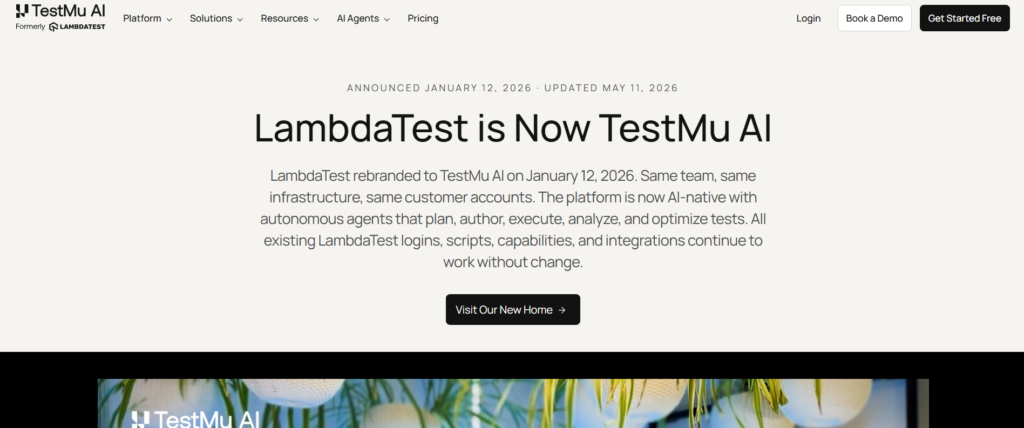
AI systems for testing require training data: lots of it, from real test runs across diverse applications and environments. LambdaTest spent years accumulating exactly this kind of data. Every test run, every failure event, every flakiness pattern, every visual comparison contributed to a dataset that would eventually power AI features.
This is not a small advantage. A startup building AI testing tools from scratch faces a cold-start problem. Without historical data, its AI models make generic predictions rather than insights derived from the specific kinds of failures that occur in real-world software testing. LambdaTest did not have this problem. Its AI features were trained on actual testing behavior from real engineering teams across many different application types, which makes them more accurate in everyday practice.
The Product That Emerged
TestMu AI is the result of applying that data advantage to the AI problems testing actually has. The failure classifier works because it has seen enough real failures across enough different application types to recognize patterns that distinguish application bugs from infrastructure issues from flaky test behavior. The flaky test detector works because it has a sufficient history of pass/fail patterns to identify inconsistency that is statistically meaningful.
The visual regression comparison engine works because it has processed enough screenshots across enough browser environments to understand the difference between rendering noise and a genuine visual change. We trained each of these features on real testing data from real engineering teams, which is why they work at a production-grade level rather than as interesting research prototypes.
What This Means for the QA Profession
The evolution from LambdaTest to TestMu AI is part of a larger shift in what QA engineering involves and what skills the role requires. As AI handles more of the pattern recognition and classification work, the value of QA engineers increasingly comes from activities that AI cannot yet perform well: strategic coverage decisions, risk-based prioritization, exploratory testing, accessibility evaluation, and quality advocacy in product discussions.
This is not bad news for QA practitioners. It is a redistribution of effort from lower-value mechanical work toward higher-value strategic work. QA engineers who engage with AI tools and adapt their practices accordingly will find their expertise more valued as a result. The discipline grows more interesting as AI takes on more of the routine tasks.
The Revolution Is Already Here
It would be inaccurate to describe the AI testing revolution as something arriving in the future. It is happening right now. TestMu AI is a commercially available platform with production-grade AI features that real engineering teams use today. Those teams are getting results: faster triage, more reliable test suites, smarter CI feedback, and better coverage decisions informed by data rather than intuition.
The LambdaTest to TestMu AI story is interesting as a rebrand story. It is more interesting as evidence that AI testing has moved from aspiration to practical reality. The platform that helped define what cross-browser testing infrastructure should look like has now taken a clear position on what AI-augmented quality engineering should look like. That position deserves serious attention from anyone working in software quality today.
Click for more articles.

- The Best HR Software For Startups in 2026: Tools Built For Growing Teams - July 14, 2026
- 5 Best Shopify GDPR Apps in 2026 - July 13, 2026
- 100 Movie Trivia Questions With Answers - June 25, 2026

